Roofer Tax Deductions:
The Complete 2026 Guide
Most roofers overpay taxes because their CPA doesn't know the deductions specific to the trades. This guide covers every legal write-off, including the three things most roofers miss completely.
Roofer Tax Deductions in 2026
- Tools and equipment (Section 179 full expensing available)
- Work vehicle: standard mileage (72.5¢/mile through June, 76¢/mile from July) or actual expense method for heavy trucks
- Home office, if you do admin work in a dedicated space
- Licensing, continuing education, and manufacturer certifications
- Liability insurance, tool insurance, and self-employed health insurance
- Retirement contributions via SEP-IRA up to $72,000 (most miss this)
- Business supplies, materials, and consumables
- Phone (business-use %) and estimating software

Deductions by Category
Tools & EquipmentCan I write off the full cost this year?
You're probably wondering: "Do I have to spread this over years or can I take it all now?" Good news, you can take it all now. The IRS has a rule called Section 179 that lets you deduct the full purchase price of tools in the year you bought them, up to $2.56 million. That $5,000 equipment setup? Fully off your taxable income this year.
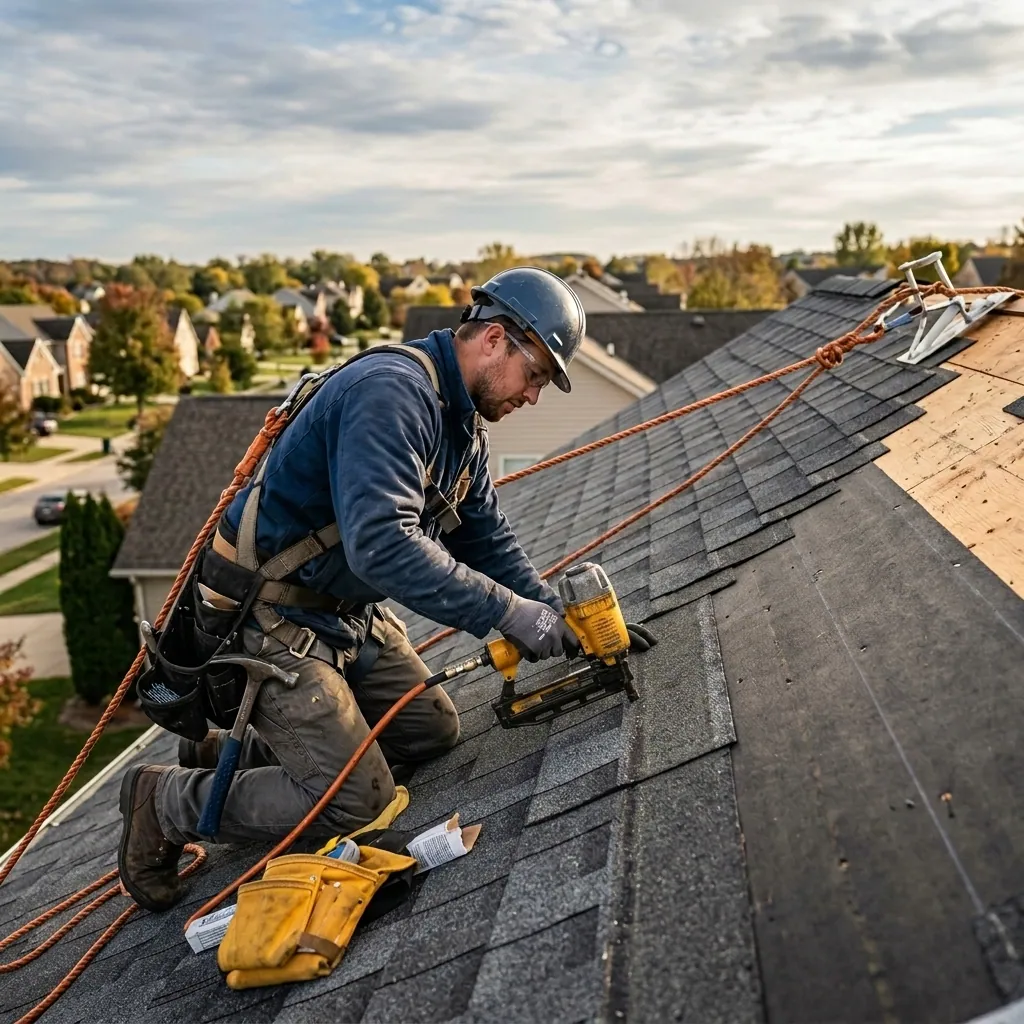
What counts? Ladders, roofing nailers, compressors, tear-off tools, roofing shovels, magnetic sweepers, harnesses, fall protection, PPE, and safety gear. If you use it for work, it belongs on your return.
What do I actually need to keep? Your receipt and a quick note about what the tool is for. That is it. Nothing complicated.
Vehicle DeductionsWhat's the best way to deduct my work truck?
You're probably wondering: "Which method saves me the most?" It depends on your truck. Simple method: standard mileage, 72.5 cents per mile through June 30, 2026, then 76 cents for the rest of the year. Track and multiply, clean and easy. But if your truck is a heavy-duty vehicle over 6,000 lbs (most crew cab trucks qualify), the actual expense method almost always wins.
What does "actual expense" mean? You add up everything it costs to run the truck, gas, oil, tires, insurance, repairs, registration, and deduct the percentage you used it for work. Plus, in the year you buy a new heavy truck, you can write off a massive chunk of its value upfront, often $15,000 to $25,000 off your taxable income in year one.
Do I really need to track every mile? Yes, both methods require a mileage log. The good news is it takes about 10 seconds per trip with a free app. A shoebox of gas receipts will not hold up if the IRS ever asks questions.
Home OfficeDo I qualify if I don't have a real "office"?
You're probably thinking: "I don't have a fancy office, just a desk where I do paperwork." That might be enough. The IRS does not require a separate room with a door. You need a space you use regularly and exclusively for work, scheduling jobs, writing proposals, sending invoices, or taking client calls.
What does "exclusively" actually mean? It means that space cannot double as something else. The kitchen table where the family eats does not count. But a corner of the guest room you have set up as your work area, and you use only for work, that qualifies. Take a photo of it, that is your documentation.
How do I figure out what I can deduct? Two options. Math way: figure out what percentage of your home's square footage that space is, then deduct that same percentage of your rent or mortgage, utilities, and insurance. Easy way: multiply the workspace square footage by $5, up to $1,500. Less money, less math.
Licensing & Continuing EdAre my license renewals and certs deductible?
You're probably wondering: "Is this actually deductible or just a cost of doing business?" Both, and because it is a cost of doing business, it is deductible. Every fee you pay to stay licensed goes on Schedule C under Licenses and Fees. State contractor licenses, local registrations, OSHA fall protection certs, and manufacturer certifications (like GAF Master Elite), all of it.
What about classes I take? If the course is required to maintain your current license or keeps you current in your trade, it is deductible. That includes any training related to roofing systems you are already installing.
Insurance PremiumsCan I deduct my health insurance and business coverage?
You're probably thinking: "I pay a ton for insurance. Is any of that coming back?" Yes, and it adds up. All your business insurance is deductible: general liability, tools and equipment coverage, commercial auto, workers' comp if you cover subs, and E&O.
Can I deduct my health insurance premiums? If you qualify, the self-employed health insurance deduction can reduce your income tax. Report eligible premiums on Schedule 1 (Form 1040). This deduction does not reduce net earnings for self-employment tax. Check the eligibility and earned-income limits in the IRS Form 7206 instructions.
Where does it go on the return? Keep this deduction separate from business insurance on Schedule C. Your eligibility and deduction amount depend on the Form 7206 rules.
Retirement ContributionsIs there a way to lower my tax bill AND save for retirement?
You're probably wondering: "Is there anything I can do before April to lower what I owe?" Yes, and this is the most underused deduction for self-employed roofers. A SEP-IRA lets you contribute up to 25% of your net self-employment income, maxing out at $72,000. Every dollar you put in is a dollar off your taxable income, and you have until your tax filing deadline to set one up and fund it.
What is the actual dollar impact? If you earned $100K this year and put $20K into a SEP-IRA, you just moved $20K off your taxable income. At a 35% combined rate, that is roughly $7,000 in taxes you do not pay this year, sitting in your retirement account instead of going to the IRS.
Is a Solo 401(k) better? It can be if you want to save more. A Solo 401(k) lets you contribute as both employee ($24,500) and employer (up to 25% of pay), with the same $72,000 combined limit. The catch: you need to set it up by December 31, while the SEP-IRA can wait until tax filing day.
Supplies & MaterialsWhat can I write off for materials I buy for jobs?
You're probably thinking: "I spend a ton on shingles and parts. Where does that go?" Materials you buy for specific jobs, shingles, underlayment, nails, flashing, drip edge, sealants, are all deductible. Under the cash method (most common), you deduct them in the year you paid for them.
What about stuff I keep in my truck as inventory? Only what you actually used this year is deductible. If you bought a pallet of underlayment and half is still in your garage, you cannot write off the whole pallet this year. Track what went out the door on jobs.
What about my work clothes? Yes, if they are clothes you would not wear off the job. Specialized roofing pants, high-visibility shirts, and steel-toed boots qualify. A polo shirt with a logo that you could wear to a baseball game probably does not.
Phone & SoftwareCan I deduct my phone and the apps I use for work?
You're probably thinking: "My phone is basically a work tool. Can I write it off?" Yes, the business-use percentage of your monthly bill and the phone itself are both deductible. Most roofers use their phone 80 to 90% for work, scheduling jobs, calling clients, taking photos on the job, estimating, navigation, and checking email. That percentage of your bill is a deduction.
What about apps and software I pay for? Fully deductible: QuickBooks, estimating apps like RoofSnap or AccuLynx, Jobber, ServiceTitan, GPS tracking subscriptions, cloud storage for job photos. If you pay for it because of your business, it is a write-off.
What about my home internet? If you have a home office, the business-use portion of your home internet is deductible as well.
What Most Roofers Miss
Quarterly Estimated Tax for Roofers
Use IRS Form 1040-ES to work out estimated payments for your situation. Our quarterly taxes guide explains the payment dates and safe-harbor rules.
| Income Period | Payment Due | Quarter |
|---|---|---|
| Q1: Jan 1 to Mar 31 | April 15, 2026 | Full quarter |
| Q2: Apr 1 to May 31 | June 15, 2026 | Short quarter |
| Q3: Jun 1 to Aug 31 | September 15, 2026 | Full quarter |
| Q4: Sep 1 to Dec 31 | January 15, 2027 | Full quarter |
Earning $75K+ Net? There's a Strategy Worth Knowing.
Once your roofing business is clearing $75,000 or more in net profit, there's a legal structure change that can put a significant chunk of money back in your pocket. It's called an S-Corp election, and it works by changing how your income is classified, reducing the portion subject to self-employment tax. Here's what the difference looks like on $100K:
I bought a bunch of tools and safety gear this year. Can I actually write those off?
Yes, and you can write them off right now, not spread over five years. The IRS has a rule called Section 179 that lets you deduct the full cost of tools and equipment in the year you buy them. That $5,000 pneumatic nailer setup or fall protection harness? Gone from your taxable income this year. The only things you need: your receipt and a note about what you used it for.
My truck hauls all my ladders and materials. How do I handle that on my taxes?
Two ways to go. The simple way: log every mile you drive for work. The IRS rate is 72.5 cents through June 30, 2026, then 76 cents for the rest of the year. Multiply, done, no math, no receipts. The better way for most roofers: deduct the actual percentage of what it costs to run the truck, gas, insurance, repairs, the whole thing. If your truck is a heavy-duty crew cab or over 6,000 lbs, the actual method almost always wins because you can write off a big chunk of the truck itself in year one. Either way, you need a mileage log. Use an app, it takes 10 seconds per trip.
I schedule jobs and do estimates from home. Does that count as a home office?
It might, and more roofers qualify than you would think. You do not need a separate room with a door. A corner desk you use only for work, scheduling jobs, running estimates, taking client calls, can qualify. The key word is only for work. The kitchen table where everyone eats does not count. A dedicated corner of a spare room you have set aside just for the business does. If you qualify, you deduct a percentage of your rent or mortgage, utilities, and insurance based on how much of your home that space represents.
Nobody told me about self-employment tax when I went out on my own. What is this thing?
Self-employment tax covers Social Security and Medicare. The standard rate is 15.3%, generally figured on 92.35% of net business profit. The Social Security wage base and Additional Medicare Tax can change the calculation. This tax is separate from income tax. You can generally deduct half of your self-employment tax when figuring adjusted gross income. Our self-employment tax guide explains the calculation.
Should I just stay an LLC or is an S-Corp actually worth it for me?
If your net profit is under $75K, LLC with Schedule C is the right move, keep it simple. Once you are clearing $75K or more, an S-Corp is worth a serious look. Here is why it works: instead of paying SE tax on all your profit, you pay yourself a reasonable salary and take the rest as distributions. Those distributions are not subject to SE tax. On $120K in profit, that structure can save $8,000 to $15,000 a year. You do need to run payroll, which adds some moving parts, but we handle all of that.
What about my licensing and manufacturer certifications? Are those write-offs?
Every dollar you spend to stay licensed or certified is deductible. Your state contractor license, OSHA fall protection, GAF Master Elite or CertainTeed certifications, continuing ed, all of it goes on Schedule C under Licenses and Fees. Create one folder on your phone and just drop every receipt in it throughout the year. Most people forget to ask about these and leave easy money on the table.
Do I really have to pay taxes four times a year? What happens if I miss one?
For calendar-year taxpayers, the regular 2026 estimated-payment dates are April 15, June 15, September 15, and January 15, 2027. Use IRS Form 1040-ES to work out estimated payments for your situation. Our quarterly taxes guide explains the payment dates and safe-harbor rules.
How do I know if hiring a specialist is actually worth the cost?
The Quarterly Estimates plan includes quarterly estimates plus a $500 credit toward your annual return. Our Pro plan covers full return filing: Schedule C, a contractor-specific deduction audit, quarterly estimates, and e-filing. Most clients find the fee comes back multiple times over in the first year, often just from getting the vehicle deduction method right or knowing where to put the health insurance deduction. Think of it this way: would you rather pay someone who works with contractors every day, or someone who also did your neighbor's W-2 last weekend?

Want Us to Find Every Deduction for Your Roofing Business?
We specialize in roofer contractor taxes. Free 30-minute call. We'll review your situation and tell you exactly what we'd do differently.